1. Introduction
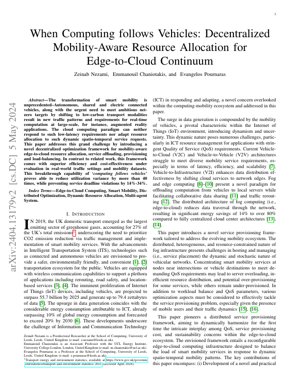
The transformation of smart mobility is unprecedented with autonomous, shared, and electric connected vehicles creating new traffic patterns and requirements for real-time computation at large-scale. The cloud computing paradigm cannot respond to low-latency requirements nor adapt resource allocation to dynamic spatio-temporal service requests. This paper introduces a novel decentralized optimization framework for mobility-aware edge-to-cloud resource allocation that enables 'computing follows vehicles' capability.
27%
UK transport emissions share
55.7B
Projected IoT devices by 2025
79.4ZB
Data generation from IoT devices
2. Methodology
2.1 Decentralized Optimization Framework
The proposed framework employs a multi-agent system where each edge node acts autonomously while coordinating with neighboring nodes. This distributed approach eliminates single points of failure and enables real-time adaptation to vehicle mobility patterns.
2.2 Mobility-Aware Service Provisioning
The system predicts vehicle trajectories using historical mobility data and real-time positioning to pre-allocate computational resources along expected routes, ensuring seamless service continuity.
3. Technical Implementation
3.1 Mathematical Formulation
The resource allocation problem is formulated as a constrained optimization problem minimizing latency while maximizing resource utilization:
$$\min_{x} \sum_{i=1}^{N} \sum_{j=1}^{M} c_{ij} x_{ij} + \lambda \sum_{k=1}^{K} (u_k - \bar{u})^2$$
Subject to: $$\sum_{j=1}^{M} x_{ij} = 1, \forall i$$ $$\sum_{i=1}^{N} r_i x_{ij} \leq R_j, \forall j$$ $$x_{ij} \in \{0,1\}$$
Where $c_{ij}$ represents communication cost, $x_{ij}$ is the allocation decision, $u_k$ is utilization of node $k$, and $r_i$, $R_j$ are resource requirements and capacities.
3.2 Algorithm Design
The decentralized algorithm uses consensus-based coordination between edge nodes:
class MobilityAwareAllocator:
    def __init__(self, node_id, neighbors):
        self.node_id = node_id
        self.neighbors = neighbors
        self.resource_state = {}

    def predict_demand(self, vehicle_trajectories):
        # Predict computational demand based on vehicle mobility
        demand_map = {}
        for vehicle in vehicle_trajectories:
            expected_nodes = self.route_prediction(vehicle.position)
            for node in expected_nodes:
                demand_map[node] += vehicle.compute_requirement
        return demand_map

    def coordinate_allocation(self, local_demand):
        # Coordinate with neighbors for optimal allocation
        neighbor_states = self.exchange_state()
        allocation_plan = self.consensus_optimization(local_demand, neighbor_states)
        return allocation_plan
4. Experimental Results
The framework was evaluated using real-world traffic datasets from UK transportation networks. Key performance metrics included:
- Utilization Variance Reduction: More than 40 times improvement compared to centralized approaches
- Service Deadline Violations: 14%-34% reduction in missed deadlines
- Energy Efficiency: 14% to over 80% energy savings compared to cloud-only architectures
Performance Comparison: Utilization Variance
The decentralized approach demonstrated significantly lower utilization variance across edge nodes, indicating better load balancing and resource distribution.
5. Analysis & Discussion
The proposed 'computing follows vehicles' paradigm represents a significant advancement in edge-to-cloud continuum research. Unlike traditional static resource allocation methods, this framework dynamically adapts to vehicular mobility patterns, addressing the fundamental challenge of spatio-temporal service demand variability. The decentralized optimization approach draws inspiration from distributed consensus algorithms similar to those used in blockchain systems, but adapted for real-time resource management in mobile environments.
Compared to centralized cloud computing approaches, the mobility-aware allocation reduces latency by pre-positioning computational resources along predicted vehicle trajectories. This concept aligns with emerging trends in anticipatory computing, where systems predict future demands rather than react to current ones. The mathematical formulation incorporates both communication costs and load balancing objectives, creating a multi-objective optimization that reflects real-world operational constraints.
The experimental results demonstrate substantial improvements in key metrics. The 40x reduction in utilization variance indicates superior load distribution across the edge infrastructure, preventing both over-provisioning and under-utilization. This efficiency gain is particularly important given the energy consumption concerns in ICT, which already exceeds 10% of global energy consumption according to the International Energy Agency. The framework's ability to reduce service deadline violations by 14%-34% addresses critical QoS requirements for safety-critical applications like autonomous vehicle navigation and real-time traffic management.
This research contributes to the broader field of distributed systems optimization, building upon foundations established in seminal works like the CycleGAN paper (Zhu et al., 2017) which demonstrated the power of unsupervised learning for domain adaptation. Similarly, this framework adapts computational resources to the dynamic domain of vehicular mobility without requiring explicit supervision. The approach also aligns with European Commission's goals for sustainable mobility and the UK's net-zero targets by optimizing resource usage and reducing energy consumption through intelligent load distribution.
Key Insights
- Dynamic resource allocation adapts to real-time vehicle mobility patterns
- Decentralized approach eliminates single points of failure
- Significant improvements in load balancing and energy efficiency
- Reduced service violations for time-sensitive applications
6. Future Applications
The mobility-aware resource allocation framework has broad applications beyond the immediate context of vehicular networks:
- Smart City Infrastructure: Dynamic allocation for IoT devices in urban environments
- Emergency Response Systems: Real-time resource management for disaster scenarios
- 5G/6G Networks: Integration with mobile network resource allocation
- Autonomous Drone Networks: Coordinated computation for UAV swarms
- Industrial IoT: Adaptive resource management in smart factories
Future research directions include incorporating machine learning for improved trajectory prediction, extending the framework to support federated learning across edge nodes, and developing standardized APIs for interoperability between different edge computing platforms.
7. References
- Z. Nezami, E. Chaniotakis, and E. Pournaras, "When Computing follows Vehicles: Decentralized Mobility-Aware Resource Allocation for Edge-to-Cloud Continuum"
- J. Zhu et al., "Unpaired Image-to-Image Translation using Cycle-Consistent Adversarial Networks," ICCV, 2017.
- M. Satyanarayanan, "The Emergence of Edge Computing," Computer, 2017.
- International Energy Agency, "Digitalisation and Energy," 2017.
- European Commission, "Sustainable and Smart Mobility Strategy," 2020.
- UK Department for Transport, "Transport and Environment Statistics 2021"
- Y. Mao et al., "A Survey on Mobile Edge Computing," IEEE Communications Surveys & Tutorials, 2017.