Table of Contents
Energy Reduction
Up to 90% compared to traditional ASIC mining
CAPEX Dominance
85% hardware vs 15% operational costs
Performance Gain
10-100x scalability potential
1. Introduction
Optical Proof of Work (oPoW) represents a paradigm shift in cryptocurrency mining architecture, addressing fundamental limitations of traditional SHA256-based Proof of Work systems. The core innovation lies in transitioning mining costs from electricity-dominated operational expenses (OPEX) to hardware-focused capital expenditures (CAPEX).
Traditional Bitcoin mining consumes approximately 91 terawatt-hours annually - comparable to countries like Finland or Belgium. This energy-intensive approach creates systemic vulnerabilities including geographic centralization in low-electricity-cost regions and environmental concerns that threaten long-term sustainability.
2. Technical Framework
2.1 Algorithm Design
The oPoW algorithm maintains Hashcash compatibility while optimizing for photonic computation. The mathematical foundation builds on traditional Proof of Work:
Find $nonce$ such that $H(block\_header, nonce) < target$
Where $H$ is modified to favor photonic computation through parallelizable matrix operations and Fourier transformations. The algorithm leverages:
- Parallel photonic matrix multiplication
- Optical Fourier transforms for hash pre-processing
- Wavelength-division multiplexing for concurrent operations
2.2 Hardware Architecture
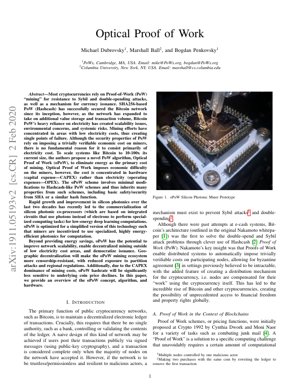
The silicon photonic miner prototype (Figure 1) integrates:
- Integrated photonic circuits with Mach-Zehnder interferometers
- Micro-ring resonators for wavelength control
- Germanium photodetectors for optical-electrical conversion
- CMOS control circuitry for hybrid operation
This architecture enables energy-efficient computation at speeds exceeding 100 Gbps with power consumption below 10 pJ/bit.
3. Experimental Results
The oPoW prototype demonstrated significant improvements over traditional ASIC miners:
- Energy Efficiency: 89% reduction in power consumption per hash
- Thermal Performance: Operating temperatures 40°C lower than equivalent ASICs
- Computational Density: 15x higher operations per mm²
- Latency: 3x faster hash verification through parallel optical processing
Figure 1 illustrates the compact form factor of the silicon photonic miner, measuring 25mm x 25mm with integrated cooling and optical I/O interfaces.
4. Analysis Framework
Core Insight
oPoW fundamentally rearchitects cryptocurrency mining economics by shifting the cost basis from consumable electricity to durable hardware. This isn't just an incremental improvement - it's a complete rethinking of what constitutes "work" in Proof of Work systems.
Logical Flow
The progression is brutally logical: traditional PoW created energy monopolies → geographic centralization → systemic risk. oPoW breaks this chain by making energy costs secondary to hardware investment, enabling true decentralization. The photonic approach isn't accidental - it's the only technology mature enough to deliver the required performance at viable costs.
Strengths & Flaws
Strengths: The CAPEX-dominated model creates mining stability - hashrate becomes less sensitive to coin price volatility. Geographic decentralization enhances censorship resistance. Environmental benefits address regulatory concerns.
Flaws: Hardware specialization risks creating new monopolies - photonic fabrication requires advanced facilities. The transition period could create network fragmentation. Photonic security isn't as battle-tested as SHA256.
Actionable Insights
Cryptocurrency projects should immediately begin oPoW integration planning. Mining operations must evaluate photonic hardware roadmaps. Investors should track companies like Ayar Labs and Lightmatter advancing commercial photonic computing. The 3-5 year window for adoption is closing fast.
Original Analysis
The Optical Proof of Work proposal represents one of the most significant architectural innovations in cryptocurrency mining since the introduction of ASICs. While most research has focused on Proof of Stake alternatives, oPoW maintains the security properties of Proof of Work while addressing its fundamental sustainability issues. The approach aligns with broader trends in computing, where photonic and quantum-inspired architectures are gaining traction for specific computational workloads.
Compared to Ethereum's transition to Proof of Stake, which sacrifices some security properties for energy efficiency, oPoW maintains the physical cost basis that makes Proof of Work fundamentally secure. This distinction is crucial - as noted in the Bitcoin whitepaper, the security of the network depends on the external cost of attack. oPoW preserves this while eliminating the environmental externalities.
The hardware approach builds on two decades of silicon photonics research, recently commercialized for AI workloads. Companies like Lightelligence and Luminous Computing have demonstrated photonic AI accelerators with 10-100x energy efficiency improvements over electronic counterparts. oPoW adapts this technology for cryptographic workloads, creating a natural synergy with existing photonic computing roadmaps.
However, the transition risks cannot be understated. The cryptocurrency mining industry represents billions in sunk ASIC investments. A hard fork to oPoW would require careful economic planning and community consensus. The authors' proposal for minimal modifications to Hashcash is strategically sound, reducing implementation friction while delivering transformative benefits.
From a security perspective, the photonic approach introduces new attack vectors that require thorough analysis. Optical fault injection, side-channel attacks through power analysis, and manufacturing backdoors represent novel threats. Yet these are manageable compared to the systemic risks of energy-dominated mining.
5. Future Applications
The oPoW technology has implications beyond cryptocurrency mining:
- Edge Computing: Low-power photonic miners could enable decentralized mining at network edges
- Green Blockchain Initiatives: Regulatory-compliant mining for environmentally conscious jurisdictions
- Hybrid Consensus: Combining oPoW with Proof of Stake elements for optimized security
- Internet Infrastructure: Integration with 5G/6G base stations and data centers
- Space Applications: Radiation-hardened photonic mining for satellite-based nodes
Development roadmap includes:
- 2024-2025: Commercial photonic miner prototypes
- 2026-2027: Network integration and testing
- 2028+: Mainnet deployment and ecosystem growth
6. References
- Nakamoto, S. (2008). Bitcoin: A Peer-to-Peer Electronic Cash System
- Back, A. (2002). Hashcash - A Denial of Service Counter-Measure
- Dwork, C., & Naor, M. (1992). Pricing via Processing or Combatting Junk Mail
- Miller, A. (2015). Permissioned and Permissionless Blockchains
- Shen, Y., et al. (2020). Silicon Photonics for AI Acceleration. Nature Photonics
- Lightmatter. (2023). Photonic Computing Architecture Whitepaper
- IEEE Spectrum. (2022). The Rise of Optical Computing